
How to start influencer marketing for a small business: one creator, one post, then decide
Updated 8 November 2026.
To start influencer marketing as a small business, skip the campaign and run one paid post with one micro influencer: pick a creator whose audience matches yours, decide what you're paying for and which lines must be in the post, agree the fee and the date in writing, check the post when it's live, pay promptly, and measure what happened. Budget $100–500 for the post. If it works, do it again with two creators; if it doesn't, you've learned cheaply.
Why one post, not a campaign
Most "how to start influencer marketing" advice is written for brands with a marketing team: build a strategy, shortlist fifty creators, run a campaign across a quarter. For a small business that's the wrong first move. You don't yet know which creators move your product, what a post should say, or what a fair fee is. One well-run post answers all three for a few hundred dollars. Agencies and platforms are for after you know it works.
The six steps
- Pick one creator. Someone whose followers are your customers: same interests, same country, same price point. Micro (10,000–100,000 followers) beats big: more engagement, lower fees, and they answer their own messages. Check their last two #ad posts; if those got a fraction of their usual engagement, their audience tunes out sponsorships.
- Decide what you're paying for. A post on their account (their reach), content for your channels (their production), or views (pay per thousand). For a first post, a Reel or TikTok on their account is the simplest to judge.
- Write the brief. The lines that must be in the post (#ad, your handle, one exact phrase, a link, how long it stays up), the date, the fee, what you can reuse. One screen.
- Reach out and agree. A short message: who you are, why them, what you'd like, by when. Share the fee with the full terms, not in the first message. Expect a counter; agree the final version in writing, dated.
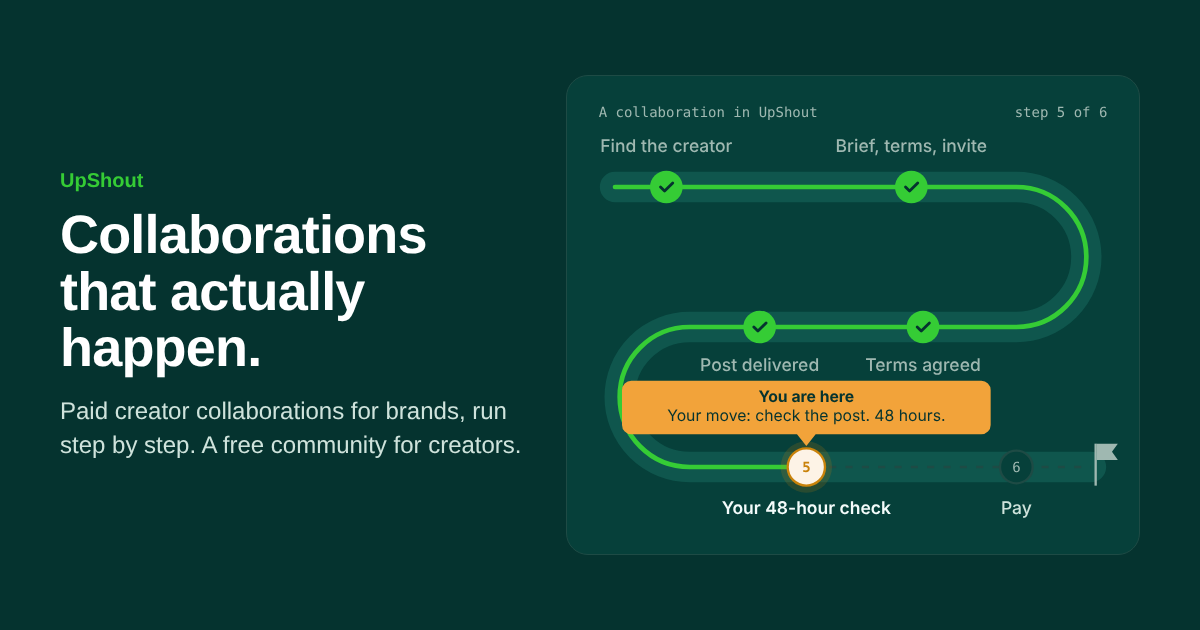
- Check, then pay. When the post is live, check it against the lines you agreed, within a window you set (48 hours is fair). Then pay, promptly, in full.
- Measure. Profile visits, link clicks, discount-code uses, sales in the week after. Compare to a normal week. That number, not the likes, tells you whether to do it again.
What it costs
The creator's fee ($100 to a few hundred dollars for a micro influencer's Reel), plus whatever tool you use to run it. On UpShout that's 5% of the fee, capped at $20, plus standard card processing charges, and no subscription; a $500 post costs roughly $536 all in, and the first one carries no UpShout fee. No agency retainer, no platform seat.
What to skip at the start
Influencer discovery databases (you can find one creator by hand), gifting-only programs (a creator you'd want is not working for free product), exclusivity clauses, and anything with a monthly fee before you've seen one post perform.
How UpShout helps
UpShout is built for exactly this first post: it walks you through the six steps in order, drafts the outreach email from your brief, keeps the agreed terms where both of you can see them, gives you 48 hours to check the post, and charges your card only when you click Pay. The creator is paid in full. Create a brand account · Try the 2-minute demo
Questions people ask
Do I need an influencer marketing agency as a small business? Not to start. An agency makes sense when you're running many collaborations a month and your time is worth more than their fee.
How much should a small business budget for influencer marketing? For the first post, $100–500 including the creator's fee. Scale from what the first post returns, not from a percentage of revenue.
Is influencer marketing worth it for a small business? It is when the creator's audience is your customer and the post is specific. One measured post tells you more than any article.
UpShout is a collaboration platform for creators and brands. Creators find audience-matched partners for shoutout exchanges and collaborations, free. Brands run paid creator collaborations step by step, with clear terms, a 48-hour check and a record both sides can see.