
Working with creators as a small brand: the five decisions to make before you message anyone
Updated 8 November 2026.
To collaborate with a creator as a small brand, decide five things before you message anyone: what you're paying for (a post, content for your channels, or views), which lines must be in the post, the date, the fee, and what you can reuse. Then write one short message that says what you'd like and when, without the fee, and keep the rest in writing where both of you can see it. That's the whole method; the rest of this post explains each decision.
Most small brands do it the other way round: find a creator they like, send a friendly message, and work out what they want once the creator asks. That's where deals go sideways: vague expectations, a post that isn't quite what you pictured, and an awkward conversation about money after the work is done. This applies whether you sell skincare, supplements, apparel, coffee, pet treats, candles, baby gear, an app, or run a café: the deal is the same shape. The five decisions take twenty minutes and they are the whole brief.
1. What are you paying for?
There are three different things a creator can sell you, and they're priced and judged differently.
- A post on their account. Their audience sees it. You're paying for their reach and their voice. Usual for a product launch or awareness.
- Content for you to post. They make the video or photos, you publish them on your own channels or in ads. You're paying for production, not reach. Often cheaper, and you control where it runs.
- Views. A post on their account, but you pay per thousand views reached rather than a flat fee. Fairer when you don't know how a creator's posts perform; it needs clear rules for over- and under-delivery (more on that below).
Pick one. Mixing them in a single deal is where confusion starts.
2. What must be in the post?
Write down the lines that are non-negotiable. Typically four or five:
- the #ad disclosure (required in the US by the FTC, and it protects you as much as the creator)
- a mention of your handle
- one exact phrase or claim you need said the way you say it (for example, how a product should be described)
- a link, and where it goes (link in bio, a sticker, the caption)
- how long the post stays up
Everything else, tone, setting, length, is the creator's craft. The more you leave to them, the better the post usually is. The lines above are what you'll check against when it's live, so keep the list short and specific.
3. By when?
A date, not "in the next few weeks". Give the creator at least ten days; good creators are booked. If the post is tied to a launch or a sale, say so, and say which day matters.
4. What's the fee?
For a small creator (10,000 to 100,000 followers), a single Reel or TikTok typically runs from around $100 to a few hundred dollars; content for your own channels is often less; views are usually priced per thousand. Those are ranges, not rules. Decide what the post is worth to you, propose it, and expect a conversation. A creator asking for more is normal; a creator accepting anything without a question is a flag.
5. What can you reuse?
Can you repost the content on your own channels? Use it in paid ads? Edit it? Decide now and put it in writing. Usage rights are the most common thing brands forget and the most common source of friction later.
How to approach the creator
Keep the first message short and specific: who you are, one honest line on why them, what you'd like (one Reel, by roughly when), and that the full terms are ready to share. Leave the fee out of the first message; it belongs with the full terms, where the creator can read everything at once. Something like:
Hi Maeve, I'm Anna, founder of Norra Skincare. Your evening-routine Reels are exactly how I'd want our serum shown. I'd like to pay you for one Instagram Reel on your account, posted in early October. The fee and the full terms are ready; if you're interested, I'll share them and we can sort the details in chat.
No reply after a few days? One polite follow-up, then move on. Creators get a lot of messages; a clear, paid, specific one stands out on its own.
Then: choose the creator with the same care
Two minutes with their profile open, four checks: are the comments from real people, is their audience where you sell, how did their last two #ad posts do, and is there anything on the feed you wouldn't want next to your name.
How UpShout helps
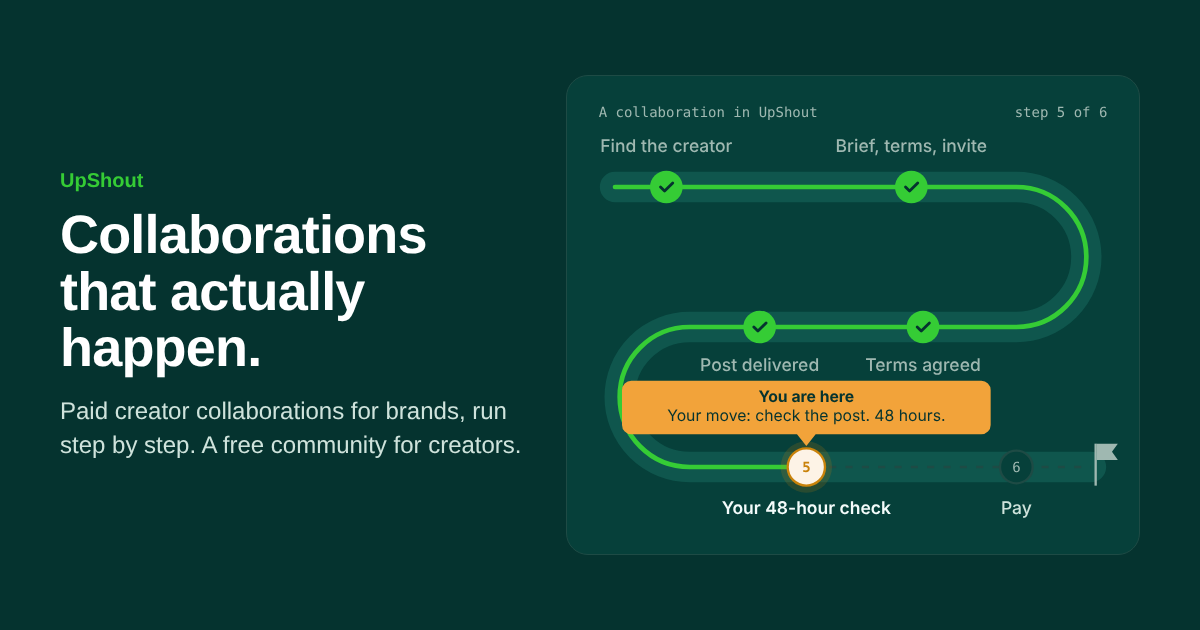
On UpShout, those five decisions are the brief, and the brief becomes the terms. You fill them in once; UpShout drafts the first message from it and sends it in your name; the creator reads the full terms at a link without needing an account; the conversation happens in a chat on the same page as the terms; and whatever you both say yes to is saved in the background, in plain words, where both of you can see it. You check the post within 48 hours of it going live and pay with one click, and the creator receives the full amount. No subscription, 5% per collaboration, never more than $20. Your first one is free.
Create a brand account · Try the 2-minute demo
Questions people ask
How much should a small brand pay a creator for a post? For creators with 10,000–100,000 followers, a single Reel or TikTok typically runs from about $100 to a few hundred dollars; content for your own channels is often less. Decide what the post is worth to you, propose it, and expect a conversation.
Do I need a contract with an influencer? You need the terms in writing, dated, where both of you can see them. A formal contract is one way to get that; a brief the creator accepts line by line is another.
Should I put the fee in the first message? No. Say what you'd like and roughly when; share the fee with the full terms, so the creator reads everything at once.
UpShout is a collaboration platform for creators and brands. Creators find audience-matched partners for shoutout exchanges and collaborations, free. Brands run paid creator collaborations step by step, with clear terms, a 48-hour check and a record both sides can see.